

INTERNATIONAL ARTISTIC LINEN CLOTH BIENNIAL
November prayer for the dead... Maria Teresa Chojnacka and Wojciech Sadley
Autumn – still life and yet ongoing death. Multicoloured, soft carpets lying under the feet like a shroud, slowly covering the ground. A blaze of colours – breathtaking palette of nature – as if a combination of events, a matter of a human’s existence, woven by hand. The abundance of crops – a metaphor for success. The darkening veils of dusk that keeps ending faster day by day create an atmosphere full of the past. August’s flickering out - reflection about life. Human – the nature of passing. November prayer for the dead.
Recently, we have seen the passing of two great artists associated with the art of fabrics – Maria Teresa Chojnacka (1931-2023) and Professor Wojciech Sadley (1932-2023). It is not possible to not mention their names during the november reflection. Both of them belonged to the generation of authors, called „Iozańczycy” by Professor Irena Huml - artists whom we thank for the triumph of the Polish artistic fabric during the initial editions of the widely-known Lozański biennial.
Wojciech Sadley – a versatile artist, professor, lecturer in many renowned universities, laureate of many awards, author of at least 200 individual exhibitions and a participant of several hundred collective exhibitions both domestic and from abroad. He took part in the first official Polish representation in the international fabric biennial in Lausanne in 1962 along with: Magdalena Abakanowicz, Ada Kierzkowska, Jolanta Owidzka and Anna śledziewska. He presented a monumental Oświęcim tapestry, „We were like wholemeal bread next to cream biscuits” – he metaphorically compared the situation of the Polish team to their taking part in an event that started a new chapter in the history of artistic fabric and brought lasting fame to the phenomenon of Polish School of Fabric. The artist had returned to Lausanne a couple of times more. In 1969, during the IV edition, he belonged to an eight-person Polish representation with Maria Teresa Chojnacka, who along with Kazimiera Gidaszewska appeared as a debutante presenting the work: King checkmate.
The merits in the field of artistic fabric and the creative legacy of both artists are impressive. They are mentioned by the most important publications, websites, major museums and other renowned cultural and art institutions, as well as experts and critics. Therefore, it is a great honor for the Museum of Crafts in Krosno to have had the direct experience of interacting with these two great personalities, for whom year 2023 marked the gateway to eternity. With great sadness, we closed the doors to the past while simultaneously opening the gate to our garden of memories, where memories of exhibitions, meetings, conversations, and works were donated to the life of the museum. In the Artistic Linen Fabric Collection of the Museum of Crafts in Krosno, there are fourteen works, and the fifteenth is currently on display as part of the eleventh International Biennial of Artistic Linen Fabric “From the loom to Krosno” at the Slovak National Museum - Museum of Ukrainian Culture in Svidnik.
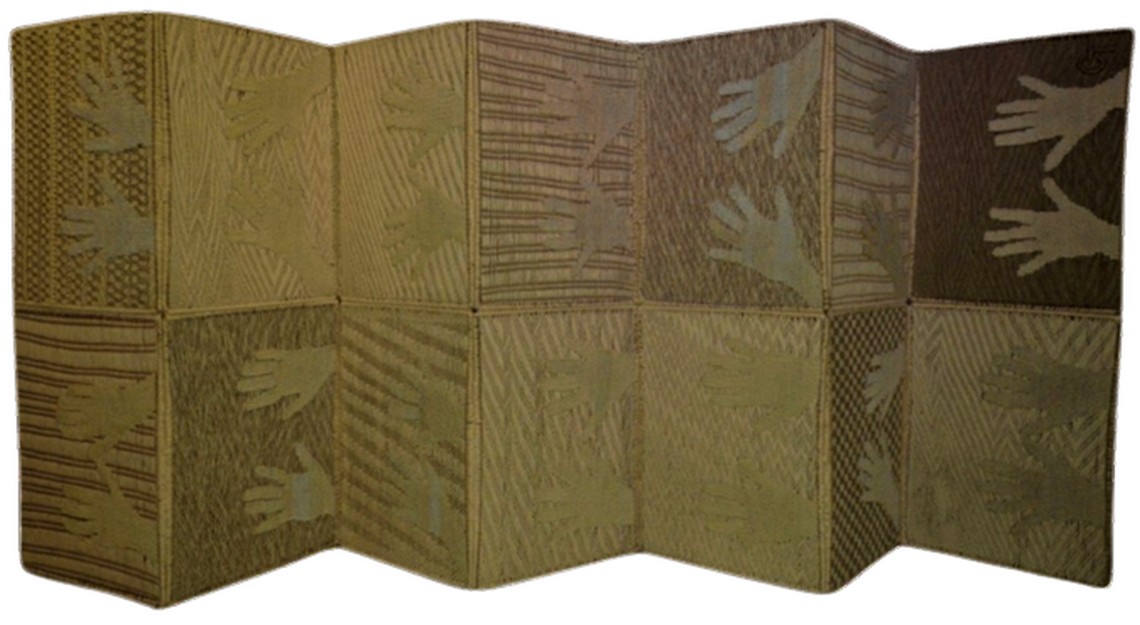
Maria Teresa Chojnacka, The Museum of Crafts in Krosno - a Time Capsule, 2016
Maria Teresa Chojnacka participated in all eleven editions of the Krosno Biennial, donating eleven works of artistic fabric to the museum collection. Our museum has had a great friend and advocate in her from the beginning. In 2016, the artist created a work titled “Museum of Crafts in Krosno - a Time Capsule” (245x90 cm, original technique: her own relief weaving). The work consists of fourteen interconnected parts and commemorates individuals associated with the organization of the “From the loom to Krosno”. Thanks to Maria Teresa Chojnacka art , we were able to leave a tangible mark in the fabric material. Commemorating individuals through woven relief images of their hands was one of the artist’s favorite themes in recent years. Human hands are subject to the creative power of human nature. They express individuality - each hand is unique and distinguishes a person from others. With their hands, people can do many good and beautiful things, but they can also cause much harm and evil. This is a very meaningful symbol, especially when it is a work of fabric art by the artist. After all, without hands, there would be no fabric. It is worth emphasizing, as Professor Irena Huml does, that "Maria Teresa Chojnacka brought an enriched understanding of weaving structure and material to fabric. Her works, subjected to strict construction rigor, were not devoid of emotions. The way the artist uses various weaves to introduce and utilize the effects of light and shadow resembles the use of sculptural relief - intricately chiseled in fabric, convex. At the same time, Chojnacka's artistic material retains all the properties of fabric - its density, roughness, shine, and inner warmth. The artist defines her own technique as a personal (original) relief weave (...) Chojnacka's creativity has thus created an ideal model of unique fabric in the convention of textural solutions, which could be considered a typical example of synthesizing the explorations of the Polish school of fabric in its crystallized form."
In the museum collection "from Krosno to Krosno" there are also four works by Wojciech Sadley. Three of those are titled “Całun” [eng. “Shroud”]. It was made in his own technique, which is combining artistic fabric with painting. In Całun from 2006, the blood-red colour scheme used by the artist emphasizes the strong message, but also evokes strong emotions in the viewer. The fabric almost bends under their weight, what was marked in the upper part. The artist intensified the effect by placing three transverse depressions in the central field of the composition - furrows, strongly accentuated with a darker line and yellow-orange light.
Maria Teresa Chojnacka participated in all eleven editions of the Krosno Biennial, donating eleven works of artistic fabric to the museum collection. Our museum has had a great friend and advocate in her from the beginning. In 2016, the artist created a work titled “Museum of Crafts in Krosno - a Time Capsule” (245x90 cm, original technique: her own relief weaving). The work consists of fourteen interconnected parts and commemorates individuals associated with the organization of the “From the loom to Krosno”. Thanks to Maria Teresa Chojnacka art , we were able to leave a tangible mark in the fabric material. Commemorating individuals through woven relief images of their hands was one of the artist’s favorite themes in recent years. Human hands are subject to the creative power of human nature. They express individuality - each hand is unique and distinguishes a person from others. With their hands, people can do many good and beautiful things, but they can also cause much harm and evil. This is a very meaningful symbol, especially when it is a work of fabric art by the artist. After all, without hands, there would be no fabric. It is worth emphasizing, as Professor Irena Huml does, that "Maria Teresa Chojnacka brought an enriched understanding of weaving structure and material to fabric. Her works, subjected to strict construction rigor, were not devoid of emotions. The way the artist uses various weaves to introduce and utilize the effects of light and shadow resembles the use of sculptural relief - intricately chiseled in fabric, convex. At the same time, Chojnacka's artistic material retains all the properties of fabric - its density, roughness, shine, and inner warmth. The artist defines her own technique as a personal (original) relief weave (...) Chojnacka's creativity has thus created an ideal model of unique fabric in the convention of textural solutions, which could be considered a typical example of synthesizing the explorations of the Polish school of fabric in its crystallized form."
In the museum collection "from Krosno to Krosno" there are also four works by Wojciech Sadley. Three of those are titled “Całun” [eng. “Shroud”]. It was made in his own technique, which is combining artistic fabric with painting. In Całun from 2006, the blood-red colour scheme used by the artist emphasizes the strong message, but also evokes strong emotions in the viewer. The fabric almost bends under their weight, what was marked in the upper part. The artist intensified the effect by placing three transverse depressions in the central field of the composition - furrows, strongly accentuated with a darker line and yellow-orange light.
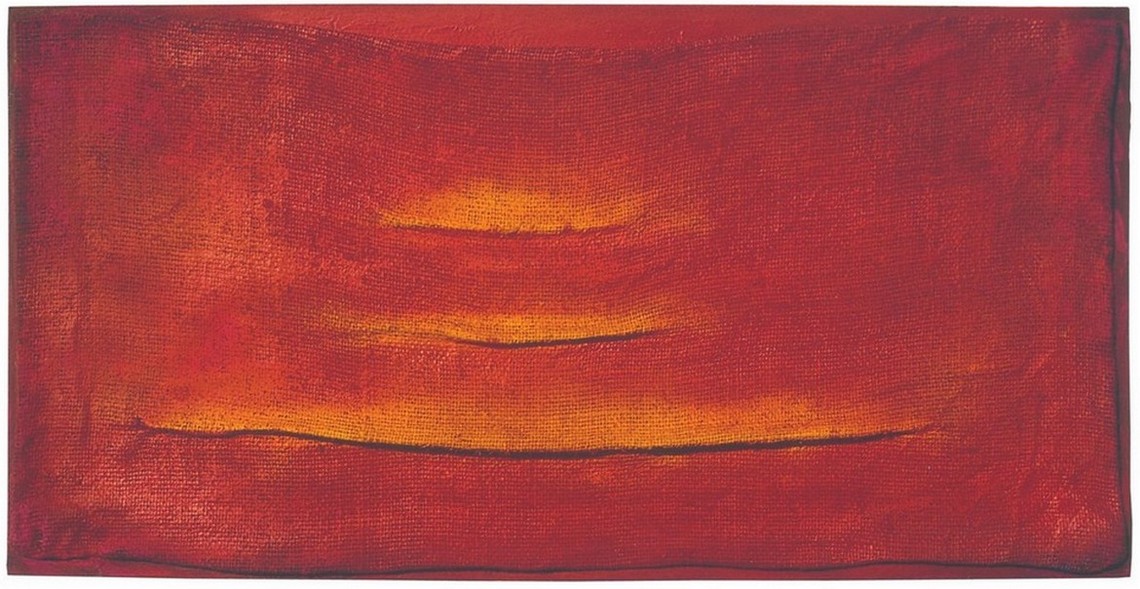
Wojciech Sadley, Schroud, 2006
The shroud motif was present in Wojciech’s Sadley work for years. That is an artistic reflection, statement, which the theme is transience. The choice of title, symbolism and method of artistic narration certainly refer to religious motifs, such as the death and resurrection of Jesus Christ. Transience can refer to a human, a valuable lesson, that the time writes in each of us. To the traces and memories left by other people - often those close to us or those that will remain after us. Wojciech Sadley often discussed the topic of transience, which is not very popular in the modern world. He pointed to the priceless value of maturity and elderly age, which time equips man with. The furrows and traces shown in the central part of the work can also be interpreted in this way. An old person is a treasure trove of traces of the past, he has a distance that helps preserve, cherish and carry memories into the future. In 2012, a series of 12 fabrics entitled Shrouds was created - created by the artist using the painted silk technique. It is in the collection of the Central Textile Museum in Łódź. The collection of the Craft Museum in Krosno includes four textiles by Wojciech Sadley from 2006, 2008, 2010 and 2012.
Maria Teresa Chojnacka and Wojciech Sadley found themselves behind the curtain of time, thus discovering the mystery of life. It is impossible to us to forget these outstanding creators, personalities and just good people. We will remember them in the Krosno Museum of Crafts not only through the works left here, but also through joint activities, organized exhibitions, meetings, conversations, and above all - a presence that the hand of time will not hide under any shroud of death.
The shroud motif was present in Wojciech’s Sadley work for years. That is an artistic reflection, statement, which the theme is transience. The choice of title, symbolism and method of artistic narration certainly refer to religious motifs, such as the death and resurrection of Jesus Christ. Transience can refer to a human, a valuable lesson, that the time writes in each of us. To the traces and memories left by other people - often those close to us or those that will remain after us. Wojciech Sadley often discussed the topic of transience, which is not very popular in the modern world. He pointed to the priceless value of maturity and elderly age, which time equips man with. The furrows and traces shown in the central part of the work can also be interpreted in this way. An old person is a treasure trove of traces of the past, he has a distance that helps preserve, cherish and carry memories into the future. In 2012, a series of 12 fabrics entitled Shrouds was created - created by the artist using the painted silk technique. It is in the collection of the Central Textile Museum in Łódź. The collection of the Craft Museum in Krosno includes four textiles by Wojciech Sadley from 2006, 2008, 2010 and 2012.
Maria Teresa Chojnacka and Wojciech Sadley found themselves behind the curtain of time, thus discovering the mystery of life. It is impossible to us to forget these outstanding creators, personalities and just good people. We will remember them in the Krosno Museum of Crafts not only through the works left here, but also through joint activities, organized exhibitions, meetings, conversations, and above all - a presence that the hand of time will not hide under any shroud of death.
Krosno, 1st November 2023
Iwona Jurczyk
The Museum of Crafts in Krosno
(translation: Dawid Fornal, Oliwier Kasprzycki, Kinga Łącka - the students of the State University of Applied Sciences in Krosno)